Fact or opinion?
THE HOLLOW FACE
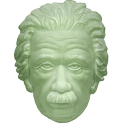
The Hollow Face Illusion (also known as the Hollow Mask Illusion) is an optical illusion in which a concave mask of a face is perceived to be a normal convex face.
This illustrates our strong tendency to see faces as being in relief, even when the visual clues indicate the contrary.
REVERSPECTIVE
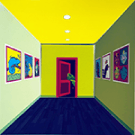
"Reverse perspectives" or "reverspectives" are three-dimensional paintings that when viewed from the front initially give the impression of viewing a painted flat surface that shows a perspective view. However as soon as the viewer moves their head even slightly the three-dimensional surface that supports the perspective view accentuates the depth of the image and accelerates the shifting perspective far more than the brain normally allows.
Patrick Hughes, a British artist who works in London, is the creator of the "reverspective". His first "reverspective" is Sticking Out Room in 1964.
https://en.wikipedia.org/wiki/Patrick_Hughes_(artist)#Art (extraits) - CC BY-SA 3.0
THE AMES ROOM

The Ames Room is an optical illusion built by the American ophthalmologist Adelbert Ames Jr. in 1946.
For this construction, it is based on a concept by Hermann von Helmholtz that dates from the late 19th century. It
is the fruit of the association of two illusions: the room seems cubic if it is observed from a specific point (seeing must be done
with only one eye, in order to rule out the stereoscopic effect, and in fact it is trapezoidal); people get bigger or smaller while
walking from one corner to the other. This effect is sometimes used in cinema as a special effect to represent people of different
sizes.
THE NON-CAMBRIDGE SURVEY
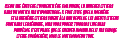
The University of Cambridge never performed a survey on this subject but the phrase has done the rounds on the internet in all languages.
Surprisingly, despite the jumble of letters inside the words, we are capable of swiftly deciphering the message. In a global context and using simple phrases, our brain swiftly deciphers and adapts to a new syntax. But just because the very specific, fairly undistorted, example of the “Cambridge” message works, there is no need to form hasty conclusions and defy good spelling.
https://www.lecture.org/revues_livres/actes_lectures/AL/AL102/AL102p023.pdf
THE AMES WINDOW
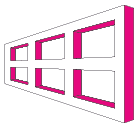
The Ames Window, or Ames Trapezoid, is a phenomenon discovered by Adelbert Ames in 1947. While rotating on its own axis, the window appears to move 180° before coming back, though it is making a full turn.
This optical illusion works because of the thickness drawn onto opposing sides of the trapezoidal window, a mirroring that tricks our brain when the window revolves around its own axis.
MACH BANDS

Mach Bands are an effect of the law of the simultaneous contrast of colours, named after Ernst Mach but known before him.
The receptors activated by strong light exert an inhibiting influence over their neighbours. Close to an abrupt transition, the light side receptors inhibit their neighbours on the dark side, and the shade is darker; and while the receptors of the middle of the light surface receive an inhibition from all parts, the ones on the edge are only inhibited by one side – so they render a lighter shade.
BUTTERFLIES

Amazing! The two butterflies are the same colour.
Our brain interprets colours according to what is immediately surrounding them. That is the contrast effect. If the butterfly appears on a light background, it will be perceived as being darker, and vice versa.
ADELSON’S CHEQUER BOARD
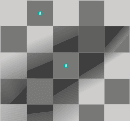
In 1995, Ted Adelson published his chequer board.
Two squares A and B, though the same colour, seem different to us. Our eye is tricked by the shadow cast by the green cylinder and the dark squares around square B (or the light squares alongside square A). It automatically rectifies and lightens B.