Believing our senses
THE PENROSE TRIANGLE

The Penrose Triangle, also known as the tribar, is an impossible object designed by the mathematician Roger Penrose in the 1950s. It features prominently the works of the artist Maurits Cornelis Escher.
Our brain is incapable of producing a stable representation of structures that break the laws of physics. In fact, we are unable to fully imagine an impossible object. At the very most, we can make it out approximately. The only way of bringing an impossible object to mind is to consider just one bit of it at a time.
https://fr.wikipedia.org/wiki/Triangle_de_Penrose (extraits) - CC BY-SA 3.0
THE CAFÉ WALL ILLUSION
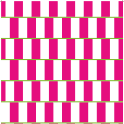
The Café Wall Illusion is an optical illusion that causes parallel right-angles to seemingly converge. Hugo Münsterberg spotted this illusion in about 1897, while Richard Gregory named it in 1979. A laboratory partner had observed this curious effect in 1973, in the pottery tiles on the exterior wall of a café in Bristol.
The columns of dark and light square are slightly offset on each row. This complex process involves multiple neuronal channels. The repetitive structure and absence of orientation points makes the illusion harder to understand and unveil.
https://fr.wikipedia.org/wiki/Illusion_du_mur_du_café - CC BY-SA 3.0
COLOURS AND MOVEMENT
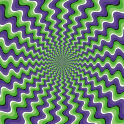
The illusion that the image is moving is produced solely in our peripheral vision. As soon as we stare right at it, it stops moving. This is not real movement but an illusion of movement: it is not the image that is moving but our eyes, which are zooming about to take in the whole of the image.
Our brain usually abstracts this activity (otherwise our view of the world would be constantly shaky), but when we look attentively at brightly coloured designs and dynamic lines, our brain is tricked: it is aware that something is moving but thinks this is the image and not our eyes.
https://lecerveau.mcgill.ca/flash/i/i_02/i_02_p/i_02_p_vis/i_02_p_vis.html
BALLS IN MOTION
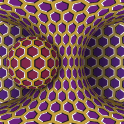
According to Mark Changizi, a neurobiologist, our brain interprets this type of depiction in order to save time: it perceives a movement, and tries to react to what comes next in its trajectory.
In this case, the curved lines associated with the sphere and the differences in shade between the planes are interpreted as indicators of movement.
THE THATCHER EFFECT
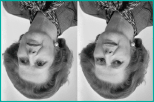
It is harder to spot isolated changes to a face when it is upside down. Once our brain has identified a human face, it is happy with this immediate response and does not deem it worthwhile to perform a lengthy, detailed analysis of the image. When the face is shown the right way up, the unusual aspect of the turned-up eyes and mouth is noticed immediately.
The Thatcher Effect bears the name of the late Prime Minister of Great Britain, Margaret Thatcher, on whose photo the effect was demonstrated for the first time. The effect was originally created in 1980 by Peter Thompson, a psychology professor at the University of York.
WATERFALL (M. C. ESCHER)
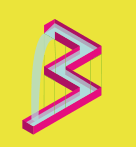
Waterfall (in Dutch: Waterval) is a lithograph by Dutch artist M. C. Escher, printed for the first time in October 1961. It depicts a perpetual motion machine where water from the bottom of a waterfall seems to run down to the top of this same waterfall.
Our brain is incapable of producing a stable representation of structures that break the laws of physics. In fact, we are unable to fully imagine an impossible object. At the very most, we can make it out approximately. The only way of bringing an impossible object to mind is to consider just one bit of it at a time.
THE NECKAR CUBE
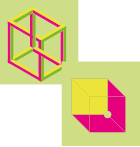
The Necker Cube is an optical illusion first published in 1832 by the Swiss crystallographer Louis-Albert Necker.
The Necker Cube is an ambiguous drawing. It is a drawing of the edges of an offset cube, which means that the parallel edges of the cube are drawn using parallel lines in the drawing. When two lines intersect, the drawing does not show which is in front and which is behind. When somebody looks at the drawing, they will see each of these two valid interpretations in turn (this is multi-stable perception).
THE PENROSE STAIRS

The Penrose Stairs are an impossible object assuming the form of a staircase. They were designed in 1958 by the British geneticist Lionel Penrose, based on the Penrose triangle created by his son, the mathematician and physicist Roger Penrose.
The Penrose Stairs are a two-dimensional representation of a staircase taking four turns at a right-angle, thus coming back to their starting point; according to common perception, the steps form a loop, constituting the perpetual rise (or descent, depending on direction of rotation); in other words, there seems to be neither a top nor a bottom of the stairs.
THE PONZO ILLUSION
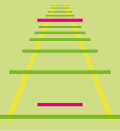
The Ponzo Illusion is a geometric-optical illusion that was first demonstrated by the Italian psychologist Mario Ponzo (1882–1960) in 1911.
Our brain recreates depth in an image which is, however, two-dimensional. The lines that get closer are interpreted as parallels becoming distant. The length of the coloured horizontal lines is therefore guessed according to how far away they supposedly are. So, our brain imagines that, while the lines are of equal length, the one that is "logically" farther away is the "larger" one.
THE EBBINGHAUS ILLUSION
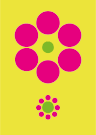
Named after its discoverer, the German psychologist Hermann Ebbinghaus (1850–1909), the illusion was popularised in the English-speaking world by Edward B. Titchener in an experimental psychology manual of 1901, which explains its alternative name.
The Ebbinghaus Illusion, or Titchener circles, is an optical illusion concerning perception of relative size. Two circles of identical size are positioned close to each other, and one is surrounded by large circles while the other is surrounded by small circles. Due to the juxtaposition of the circles, the middle circle surrounded by big circles seems smaller.
CHROMATIC CONTRAST
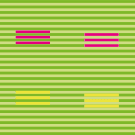
The observed change of colour is due to the surrounding pink and yellow colour.
Our brain interprets colours according to what is immediately surrounding them. That is the contrast effect. If the colour appears against a light background, it will be perceived as darker, and vice versa.
https://illusionsdoptiquetpeblog.wordpress.com/2017/02/26/les-illusions-de-couleur/
MY WIFE AND MY MOTHER-IN-LAW

The American caricaturist William Ely Hill (1887–1962) published “My Wife and my Mother-in-Law” in Puck, an American humour magazine, on 6 November 1915, with the caption “They are both in this picture – Find them”.
However, the oldest known version of this picture is a German postcard from 1888. In 1930 Edwin Boring introduced the figure to psychologists in a paper titled “A new ambiguous figure”, and it has since appeared in textbooks and experimental studies.
ARROWS LEFT OR RIGHT
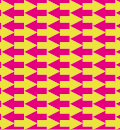
An ambiguous drawing. Multiple interpretations are possible. We either see dark-coloured arrows pointing right, or light-coloured arrows pointing left – or even both at once.
This drawing enables us to approach the concept of different "truths", and the importance of crossing gazes and points of view.
THE BLIVET
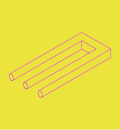
The blivet is an indecipherable figure, optical illusion, and impossible object, all at once. It was recognised in 1964, and put on the cover of the magazine Mad from March 1964. It is also called the "two-pronged trident", the "devil's fork", the "impossible trident" and "the thing with three legs".
The one-piece object seems to be made up of one extremity comprising three cylindrical tines and the other extremity comprising two rectangular tines joined by a rectangular bar. A fork starting with two rectangular tines transforming themselves into three cylindrical tines. The only way of bringing an impossible object to mind is to consider just one bit of it at a time.
THE KANIZSA MOTIF

The Kanizsa motif is a cognitive optical illusion published by Gaetano Kanizsa in 1955. Our binocular vision enables us to reconstruct partially hidden objects (back in times when creatures were concealed behind foliage, it was vital for our ancestors to be able to identify them swiftly).
Even today, we are often tempted to reconstruct the "missing" part of a drawing, lengthening sections of straight line as we imagine shapes (yellow triangle) that apparently partially obscure known objects or shapes (green triangle).
THE NEGATIVE PORTRAIT
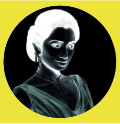
This optical illusion arises as a result of retinal perception. The light that sends the image to your eye marks the retina. While looking at the photo for the first thirty seconds of the experiment, you over-stimulate the cells that make up the photoreceptors in your eyes.
When you close your eyes, you will still faintly see the areas that were not touched by the light, and the areas that were illuminated have gone out. The outcome: you are seeing this image in its negative!
https://www.fredzone.org/cette-illusion-doptique-ne-laissera-personne-indifferent-224
AMBIGUOUS IMAGES

Ambiguous images or reversible figures are visual shapes that create ambiguity by exploiting graphic similarities and other of the visual system’s properties of interpreting between two or several distinct image shapes.
These are reputed to induce the “multi-stable” phenomenon of perception, that is to say the occurrence of an image capable of supply multiple perceptions without changing its appearance.